
Chemical Quote Automation Needs Prices That Hold
What quote automation should check before a chemical quote goes out, so the margin you quote is the margin you keep when a supplier's next increase lands.
The numbers here
Somewhere on your last chemical quote, a line says how long its price holds. At many lubricant distributors that line has said 30 days for years, JobbersWorld notes, and for most of the past decade it matched the market. A supplier's price increase took effect about 30 days after it was announced.
Spring 2026 cut that to 14.6 days on average, across 37 increases from 19 companies in JobbersWorld's June analysis. That's the test for quote automation in chemicals. A quote takes minutes to build, but its price has to stay true until your client says yes, and your own cost can now change in about 2 weeks.
How long your cost holds depends on who you buy from.
JobbersWorld's paper split the 19 companies into 3 groups. Small and regional suppliers gave the least time between announcing an increase and charging it, 12.4 days on average. Major oil companies gave 21.9 and large independents 25.8, and some independent blenders put increases through in as little as 1 to 3 days.
JobbersWorld, June 2026
Your cost now goes up halfway through a 30-day quote.
Each bar starts the day a supplier announces an increase and your quote goes out. Pick how long your quote holds its price.
Days your cost hasn't changedDays your cost is up and your quoted price isn't
Margin figures assume a 20% margin on the order.
Then and now
- 2013 to 2019 averageCost up after about 30 daysDays your cost is up and your quoted price isn't0 days
- 2021 to 2022 averageCost up after about 29 daysDays your cost is up and your quoted price isn'tabout 1 day
- Spring 2026 averageCost up after 14.6 daysDays your cost is up and your quoted price isn't15.4 days
Spring 2026, by supplier
- Some independent blendersCost up after as little as 1 to 3 daysDays your cost is up and your quoted price isn't27 to 29 days
- Small and regional suppliersCost up after 12.4 daysPrice rise up to 11.5%Days your cost is up and your quoted price isn't17.6 days10.8% margin left
- Major oil companiesCost up after 21.9 daysPrice rise up to 14.9%Days your cost is up and your quoted price isn't8.1 days8.1% margin left
- Large independentsCost up after 25.8 daysPrice rise up to 13.0%Days your cost is up and your quoted price isn't4.2 days9.6% margin left
Assumes your quote goes out the day the supplier announces. Spring 2026 covers publicly announced lubricant increases from 12 March to 29 May. The earlier averages come from JobbersWorld's archive and are approximate. The margin is on an order filled at the new cost and sold at your quoted price. Each rise is the average top of the range that group announced on its first increase in spring 2026, so a real rise may be smaller.
The 2026 Lubricant Pricing Cycle: Data, Dynamics, and the Emerging Role of Supply Constraints2 Jun 2026
Your client can still buy at the old price after your cost rises.
That's where the margin goes. An order placed in those days and filled from stock bought at the new cost earns less than the margin you quoted. On a 30-day quote, the spring 2026 average leaves about 2 weeks of them.
JobbersWorld drew the same conclusion for distributors. The 30-day price protection many have offered their own clients, it wrote, "is no longer sustainable as suppliers move in half that time."
Hold a quoted price no longer than your suppliers hold your cost.
The data is a single season of lubricant prices.
JobbersWorld counted only publicly announced, broad-based increases reported between 12 March and 29 May 2026, and it says the data may not include every supplier's moves. Business on contract moves on the contract's own terms.
Its author traced the increases to supply constraints that "appear to be structural and geopolitical in origin," and saw signs of a 4th round when the paper came out. In September, Adhesives & Sealants Industry reported BASF raising MDI and TDI prices in ASEAN and South Asia with immediate effect, and Oxea raising n-octylamine prices from 1 October, 17 days after the report.
Check 5 things before a chemical quote goes out.
Run them on the next quote your team sends, by hand or in your quote management software.
How fast your cost can move. Look up how many days each supplier on the quote gave between announcing its last increase and charging it. Hold the price no longer than the shortest, or say on the quote what happens if your cost moves first.
Today's cost on every line. Price each line from what it would cost to replace the stock now, not from last month's list.
The stock behind the quote. Know which lot or batch will fill it and what that lot cost, so you see the real margin before you send it.
The credit the account has left. Check the headroom first, so a yes doesn't stall in credit review.
Terms from the agreement. Copy the terms from the client's agreement on file, never from the last quote you sent.
In the spring cycle, half of the lubricant price increases JobbersWorld counted were in force within 14 days of being announced.
Quote automation is only as current as the records behind it.
General AI models can draft a quote in seconds. They can't see this week's cost, the lot on your shelf, or what the account has left on credit, because those live in your own systems.
Vailent runs above those systems, on your own data, walled off from every other company's. Pipeline builds the quote from it. Every line carries its offered price and its quantity as you build it, with currency, incoterms, payment terms, and packaging taken from the agreement. Quotes draw on live stock and batch margin, and the credit limit, what is left of it, and current exposure are read from your ERP.
See how Pipeline builds a quoteSources.
- The 2026 Lubricant Pricing Cycle: Data, Dynamics, and the Emerging Role of Supply Constraints JobbersWorld, a white paper by Thomas F. Glenn of Petroleum Trends International on 37 lubricant price increases from 19 companies.Published 2 Jun 2026 · Checked 20 Oct 2026
- BASF Raises Prices for MDI and TDI in ASEAN and South Asia Countries Adhesives & Sealants Industry.Published 17 Sep 2026 · Checked 20 Oct 2026
- Oxea Raises Prices for n-Octylamine Adhesives & Sealants Industry.Published 14 Sep 2026 · Checked 20 Oct 2026

See what AI-native operations look like
Vailent embeds AI into the daily work of chemical and polymer distributors and producers: quoting, onboarding, inventory, and daily intelligence.
Book a DemoKeep reading
The AI Divide Has Reached Chemical Distribution
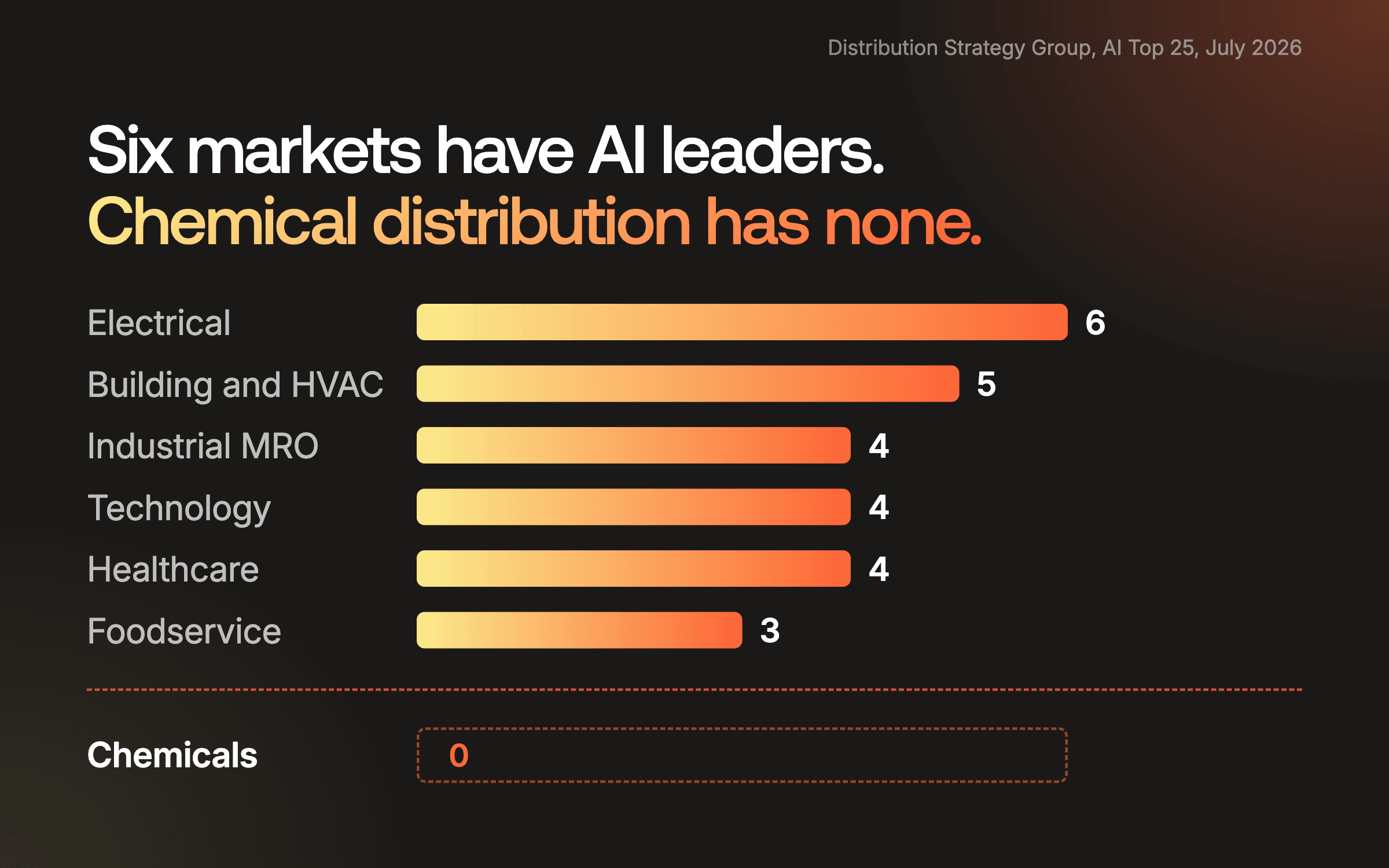
Distribution Strategy Group checked 300+ distributors for AI in production. 26 passed. Not one is a chemical distributor. Here's what they did first.

Chemical AI Should Take the Busywork. People Keep the Hard Cases.
Every chemical distributor is getting the same AI tools at once. The edge left is judgment, and people only build it on the work AI shouldn't take.
AI-Native Infrastructure Starts on the Commercial Floor
Most AI spending in chemicals aims at the plant. The hours actually go to quoting, onboarding and the technical answer a customer is waiting on.